 incontinence Direct
A Calm, Discreet Place to Begin
incontinence Direct
Some health concerns sit closer to the chest than others. For the bladder, bowel, pelvic floor and intimate symptoms many people carry in silence, this is a space designed to feel calm, considered and human from the very first moment.

Bladder leaks. Sudden urgency. Frequent trips to the bathroom. Changes in bowel control. Pelvic floor weakness. Intimate health issues that quietly begin to interfere with confidence, movement, relationships, travel, work or simple daily living.
These experiences are far more common than most people realise, yet they are rarely easy to put into words. Many spend months, sometimes years, adjusting around symptoms before ever mentioning them out loud. There is nothing unusual about that. Sensitive concerns ask for a different kind of starting point.
The hardest part for many people is not the symptoms themselves. It is the way a small set of concerns can gradually shape the rhythm of every day. Planning around toilets before a trip. Keeping a change of clothes nearby just in case. Feeling a quiet flicker of anxiety in social situations. The private worry that life has begun to be built around something nobody else has noticed.
This space exists for that exact moment. The moment someone decides they would like a softer, more thoughtful path forward. One that handles delicate issues with care, has time to listen, and keeps its attention on what matters most: helping people feel more comfortable, more confident and more in control of their own day.
People do not live in clinical language. Even when symptoms are described in formal terms, they are experienced in very real, very human moments. A small leak during a meeting. A sudden urge in heavy traffic. A hesitation before exercise. A change in intimacy. A night cut short, again and again. A laugh that no longer feels free.
From the outside, these moments can look minor. From the inside, they often feel enormous. They build up quietly, layer by layer, until a person has rearranged a great deal of their life without ever quite naming why.
A symptom is rarely just a symptom. Over time it can shape sleep, posture, confidence, travel plans, work life, relationships, exercise and self-image. It can introduce a sense of shame where none is needed. It can quietly turn straightforward routines into careful planning exercises.
Good support recognises this. It responds with calmness, precision and genuine warmth. It does not race through a checklist or reduce a person to a set of boxes. It listens, makes sense of what the symptoms mean in everyday life, and moves forward at a thoughtful pace.
If symptoms feel personal, support should feel personal too. Not rushed. Not impersonal. Not built around the assumption that someone needs to explain themselves any more than they already have.

incontinence Direct offers discreet, considered support for people living with bladder, bowel, pelvic floor and intimate health concerns. The journey is designed to feel straightforward and reassuring from the very first contact, and consistent through every step that follows.
It is a calm environment for people who may be coping with a wide range of related concerns, including:
Stress-related leaks, mixed symptoms, and small but persistent changes that begin to interfere with confidence in everyday situations.
Overactive bladder symptoms and frequent trips to the toilet that quietly begin to shape travel, work and social life.
Sensitive symptoms that often go unmentioned, met here with respect, dignity and a clear, manageable path forward.
Changes that may follow childbirth, surgery, ageing or simply the passage of time, addressed in a non-surgical, person-centred way.
Issues that quietly affect comfort, confidence and connection, given the careful attention they deserve.
Areas such as erectile health, where the experience often touches both the physical and the emotional sides of daily life.
The aim is straightforward: to offer individualised support that feels human, dignified and achievable. People often arrive looking for something different from what they have found elsewhere. They may not want a complicated route. They may not want to feel rushed, or exposed, or treated as a case rather than a person. They want a space that recognises how delicate their concerns are and meets them with the same quiet care.
A great many people put off seeking support far longer than they need to. Not because the concern is small, but because it can feel awkward, inconvenient or hard to name. The reasons are easy to recognise:
Each of these is understandable. Yet waiting tends to add an unnecessary weight that is rarely visible to anyone else. It chips away at confidence in small ways every day.
A more considered service is for the moment a person feels ready to do something about it. Not in a dramatic way. Not in a rush. Simply in the calm, honest way most people would prefer to live with. The first step does not need to be a perfect one. It only needs to be honest.
When a concern is personal, privacy stops being a detail and becomes a foundation. People do not just want to be helped. They want to feel that their experience is genuinely cared for. They want assurance that nothing will feel pressured, awkward or exposed.
A culture of discretion shapes everything here. The tone is quiet. The approach is respectful. The focus is on creating room for honest conversation, because that is so often where the most meaningful support begins.
That sense of privacy is not an extra. It is woven through the whole experience: in how information is presented, in how concerns are discussed, in how people are gently encouraged to share what is really going on without any sense of self-judgement.
Symptoms are experienced differently by different people. One person may feel hit hardest at work. Another may find that travel has quietly become limited. Someone else may feel fine during the day and restless at night. Another may notice symptoms most clearly during exercise. For some, the deepest concern sits around intimacy and confidence. Others find a cluster of issues woven together in ways that are hard to separate.
A thoughtful service does not feel one-size-fits-all. It is built around the recognition that people arrive with different symptoms, different routines, different concerns and different goals.
The right support starts with what matters to the individual person, not what looks tidy on paper. It begins with the actual texture of everyday life.
 Circumstances vary, but the reasons people are drawn to a service like this often come down to a small set of shared hopes.
A genuine sense of being seen as a whole person, not as a list of symptoms to be processed.
Non-surgical pathways where appropriate, designed to be discreet, practical and easy to consider.
An experience that respects the everyday demands of work, family, travel and personal time.
A space where people do not feel they need to justify the seriousness of their concerns.
Care that handles delicate topics with warmth, while remaining clear, calm and confident.
Information shared in a way that supports informed choices, never in a way that pressures them.
Helpful support does not always announce itself with dramatic results. More often it shows up as the small, steady shifts that make daily life feel a little lighter.
That is what a really good kind of support can offer. It does not need to transform everything overnight to be meaningful. Sometimes the most valuable change is a quiet one: feeling more grounded in your own body, and a little better equipped to take part in ordinary life again.
The aim is not only to address symptoms. It is to help confidence, dignity and ease return to daily life.
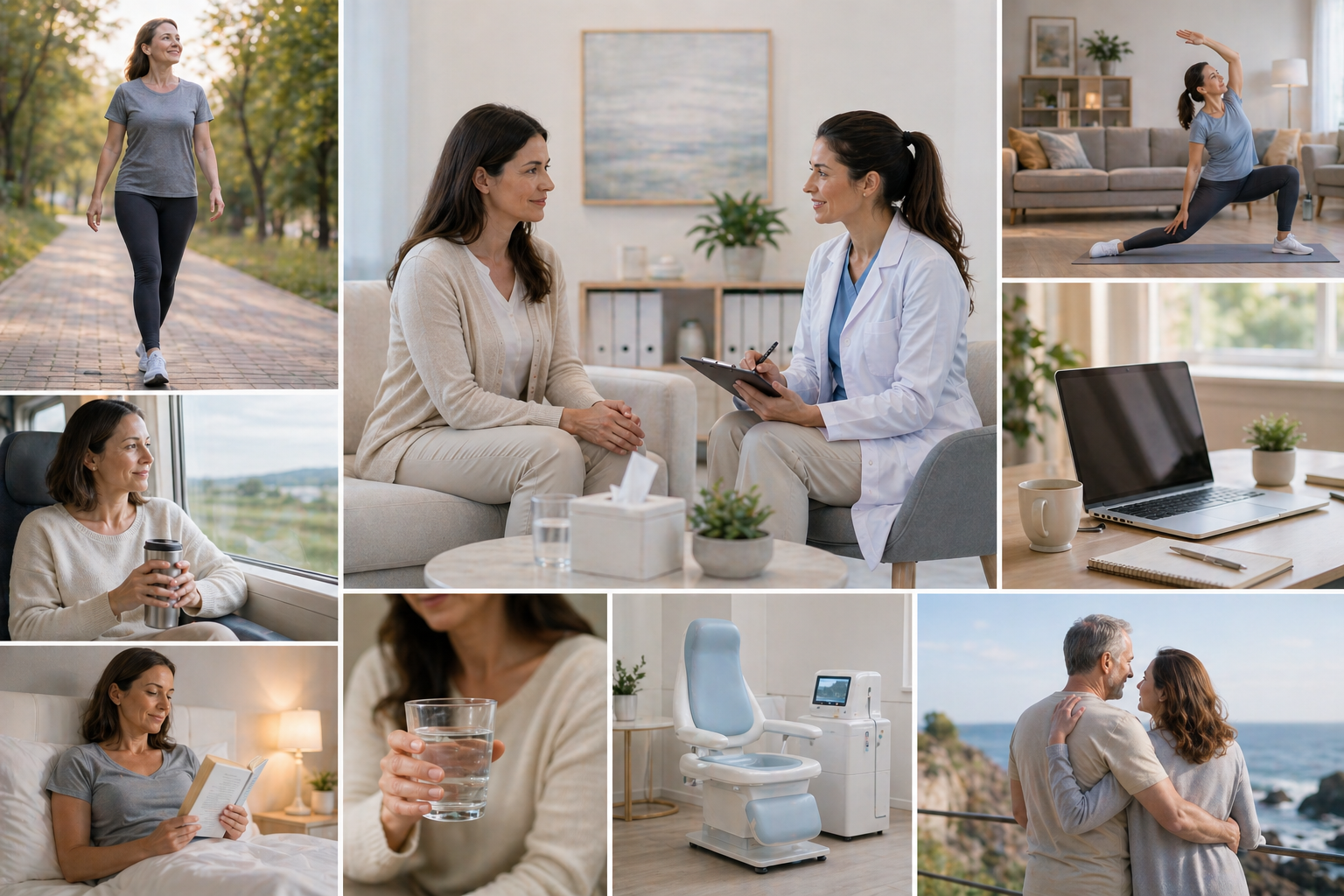
People do not live their lives in clinic rooms. They live them between work and home, between school runs and errands, between long days and longer evenings, between shared responsibilities and quiet private worries. A good service respects all of that.
Care should feel functional and warm at the same time. It should fit into the way people actually live, not ask them to rearrange their lives around it. It should recognise that what is needed is not only practical, but emotionally considerate too.
Stepping into support should feel simple, never complicated. There should be room for questions. Assumptions about what someone already knows or feels should be left at the door. The aim is to move people gently from uncertainty toward clarity, without ever making them feel small along the way.
The early conversation is about understanding. Which symptoms are present? How long have they been there? What seems to make them better or worse? How are they affecting daily life? What has already been tried? What feels most urgent to change?
From there, the next step is a calm conversation about what might help. The path forward is shaped around the individual, never the other way round. A thoughtful approach does not overwhelm with information too early. It shares enough for the person to understand their options and feel comfortable with what comes next.
Where suitable, a non-surgical route is often the preferred starting point for those looking for help with continence and related concerns. Many people are looking for something less intrusive, more convenient or simpler to fit into a busy life.
For some, this offers a way to begin without feeling overwhelmed by the prospect of more significant intervention. For others, it sits alongside other forms of care. The important thing is that the person feels informed, respected and supported in making a confident choice.
Life is busy, and personal health concerns rarely arrive at convenient moments. Some people feel more at ease receiving support at home. Others appreciate the structure and quiet focus of a clinic environment. Both have their place, and the best fit often comes down to what feels easiest to manage on a given day.
Flexibility is especially important when symptoms have already created a sense of quiet stress. Removing small barriers makes the next step feel possible. That is not a luxury. It is part of thoughtful, modern care.
Many people have become quietly skilled at coping. They know where every bathroom is on a familiar route. They have learned how to sit during long meetings. They know which clothes feel safest. They map out the quickest routes home. They have become experts at appearing perfectly fine.
Coping like this takes energy. A lot of it. Over time, it can become so familiar that people forget what ease used to feel like. They forget there is no rule that says they have to keep working around a problem forever. They forget that thoughtful support is also for them.
This kind of service is for the person who has carried things in private for too long. The one who has adjusted to the point of no longer noticing how much adjustment they are doing. The person who is quietly ready for things to feel a little less effortful.
The first goal does not have to be perfection. Often the first goal is simply relief.
Symptoms are not always called by the name people most want to use. People might describe leaks, urgency, accidents, interruptions or unease. Underneath those words, what many are really hoping for is something far more human: confidence.
This is why support has to be both practical and emotional. Easing one symptom in isolation does little if a person still feels anxious, watchful or unsettled. The wider experience matters. Confidence is one of the quiet but important outcomes a thoughtful service is designed to support.
Some people delay seeking help because they worry no one will take them seriously. That fear is understandable. Sensitive symptoms can be hard to describe. Some people have been told before that what they were feeling was normal. Some worry they will be brushed past. Others wonder if they have waited too long, or whether they should have spoken up sooner.
The right kind of service eases that fear as much as possible. Concerns are met seriously without ever being treated as alarming. People feel that what they are experiencing genuinely matters, even when it does not look dramatic from the outside. Personal discomfort is treated as discomfort that deserves attention, full stop. That is what trust is built on.
A care experience is not made memorable only by its outcome. It is also shaped by how the journey itself feels along the way.
From the very first interaction through to follow-up conversations, the experience should remain composed and human. Plain language. Room for questions. A pace that feels considered. Real listening, not just label-spotting.

Men and women experience continence concerns, pelvic floor changes and intimate health issues differently, but the emotional weight is often very similar. People want discretion. They want practical help. They want relief. They want to feel like themselves again.
This is a calm space for adults of any gender who are ready to address sensitive concerns in a private, considered way. Some people are looking for help with bladder symptoms. Others are most concerned about bowel control. Some are adjusting after a life change, recovery or simply the passage of time. Some are working through concerns that feel deeply personal. Whatever the reason, the response remains the same: steady, respectful and focused on genuine help.
This part is rarely spoken about, but it matters. When symptoms continue for long enough, they can quietly seep into a person's sense of self. People may feel less spontaneous. Less confident. Less active. Less at ease around others. Sometimes even less like the person they remember being.
That is a heavy thing to carry quietly. Support that focuses only on the physical side is missing part of the picture. The right kind of care also recognises that identity can take a knock when the body starts behaving in ways that feel inconvenient, unpredictable or embarrassing. Compassion belongs there as much as anywhere.
Everyone is at a different point of readiness. Some prefer to read quietly first. Some compare options. Some take time to gather the courage for a first conversation. Others know they need help but want a little reassurance before they begin. A respectful service understands all of that.
Nobody should be rushed beyond what feels comfortable. Information should be shared in calm, clear terms. People should feel free to move forward at their own pace. That flexibility is especially meaningful when the topic is sensitive. When someone feels their comfort has been considered from the very beginning, they are far more likely to engage openly.
Medical terminology has its place, but it can feel impersonal, especially when someone is already feeling anxious or self-conscious. Wherever possible, the language used here is simple, warm and human. Sentences that need to be decoded do not belong in a service that is meant to feel reassuring.
Clear language builds confidence. It eases worry. It helps people ask better questions. That simplicity is not a weakness. It is a kindness, and a deliberate one.
For someone who has felt tense about their symptoms for months or years, a calm tone can be deeply reassuring. Calm does not mean casual. It means composed, steady and considerate. It means an experience designed to be easy to step into and easy to continue with. The first emotional barrier is often simply starting. Once that becomes lighter, much of what follows feels more imaginable.
Most people arrive carrying questions that have not yet become words. The quiet ones, asked silently long before any conversation begins.
These questions are real, and they deserve thoughtful answers. A genuinely good service expects them rather than ignoring them. It responds with patience. It explains clearly. It avoids pressure. It creates a space where uncertainty has room to settle.
Quietly seeking help is not a sign of weakness. There is no lack of dignity in wanting to feel better. There is, in fact, real dignity in admitting that something is affecting daily life, and choosing to no longer carry it alone.
That dignity is reflected in the way care is delivered. Sensitive topics are not approached with sensationalism or awkwardness. They are treated as a legitimate, ordinary part of health and wellbeing. For someone who has felt self-conscious for a long time, that respectful framing alone can be a quiet relief.
Sometimes dignity is found in something as simple as being heard, being understood, being given a clear next step, and being treated as a person rather than as a problem.
It is a discreet, human-centred space designed to support people living with bladder, bowel, pelvic floor and intimate health concerns. The experience is calm, considered and respectful, created for those who want help on their own terms, without feeling rushed or exposed.
It is for adult men and women living with urinary leakage, urgency, frequency, overactive bladder symptoms, bowel control concerns, pelvic floor weakness or other sensitive intimate health issues that are beginning to affect daily life.
Yes. Many people quietly cope for a long time before they feel ready to ask for help. This is exactly the kind of moment a more considered approach is built for.
Where appropriate, the focus is on supportive, non-surgical pathways. The exact approach is always shaped around the individual and what feels right for them.
Privacy and discretion are central. Everything from the tone of the conversation to the way information is shared is designed to help people feel safe discussing sensitive concerns.
If a symptom is affecting your comfort, confidence, sleep, routine or peace of mind, it is worth acknowledging. There is no need to wait until things feel severe before exploring support.
It is designed to feel clear and manageable. Each step is explained simply, so the path forward never feels confusing or overwhelming.
Not at all. These concerns can affect adults at many points in life. What matters is whether symptoms are impacting daily living, not age.
Because sensitive subjects often come with embarrassment, anxiety or hesitation. A steady, kind tone can be the very thing that helps a person feel comfortable enough to be honest, which is usually the first step toward meaningful support.
Living with bladder, bowel, pelvic floor or intimate health concerns can be quietly tiring, especially when so much of the burden is invisible to others. The planning, the worry, the small daily adjustments all add up over time.
A more compassionate kind of care is gentler, quieter and more personal. It respects privacy. It handles sensitive topics carefully. It keeps its focus on helping people through realistic, humane steps rather than rushed processes.
For those who have been carrying things in silence, this can be a small but meaningful first step. A step toward more comfort. More confidence. More ease in daily life. More space to focus on something other than symptoms throughout the day.
The right support should never feel cold, rushed or distant. It should feel steady, clear and kind. Above all, it should feel human. That is the quiet promise behind every part of this service.