 incontinence Direct
Considered, Non-Surgical Support
incontinence Direct
Calm, non-invasive care brought together in one place. A thoughtful approach to bladder, bowel, pelvic floor and intimate health, designed to feel as understated in real life as it sounds on the page.

There are very few health concerns that people share comfortably. Some sit much closer to the heart. Bladder leaks. Sudden urgency. Frequent trips to the bathroom. Bowel control worries. Pelvic floor weakness. Common but rarely-mentioned intimate health changes that quietly affect confidence, movement, sleep, travel, work and relationships.
For so many people, the hardest part is not the symptoms themselves. It is the way those symptoms slowly shape everyday life. It is the careful planning that goes into every outing. The wardrobe choices, the timed routines, the small adjustments. The quieter laugh, the cautious lift, the gentler pace at the gym. The unspoken worry that someone might notice. The feeling that life has narrowed around something deeply personal.
This service exists for the moment a person decides they no longer want to carry this alone. The approach is intentionally calm, unobtrusive and reassuring. It offers a human path forward for adults seeking support that is practical, personal and easy to step into. For those wondering more about recovery, Can Incontinence Direct Cure Incontinence offers additional insight. No drama. No pressure. No awkwardness. Just thoughtful care that recognises how truly personal these concerns can be.
It is for anyone who wants to feel a little more at home in their body, a little more at ease in daily life, and more in control of symptoms that may have been quietly normalised for too long.
Bladder, bowel, pelvic floor and intimate health changes can affect adults at many points in life. Some notice a difference after childbirth. Some after surgery. Others see them appearing alongside the natural changes of ageing. For those specifically wondering about bladder symptoms, Will Incontinence Direct Help Urinary Incontinence offers more focused guidance. Some have lived with them for years without ever speaking up, while others find themselves troubled by something that has only recently begun.
Part of what makes these concerns particularly difficult is that they are usually invisible. From the outside, a person can appear perfectly well, while quietly working around leaks, urgency, discomfort or worry. They may step back from things they used to enjoy. They may avoid certain clothes, settings, movements or conversations. They may tell themselves they should simply get on with it.
That kind of quiet coping can continue for a long time. The aim of this service is to offer a different kind of starting point. A non-surgical, discreet approach that feels as understated in everyday life as it sounds on paper. By bringing several closely related areas of care together in one place, the journey itself becomes easier to understand and easier to begin.
The tone is intentionally human. Steady language. Plain explanations. Just enough structure to keep the focus where it belongs: not on a label, but on the real-life impact of the symptom, the emotional weight that comes with it, and the kind of support that genuinely helps.
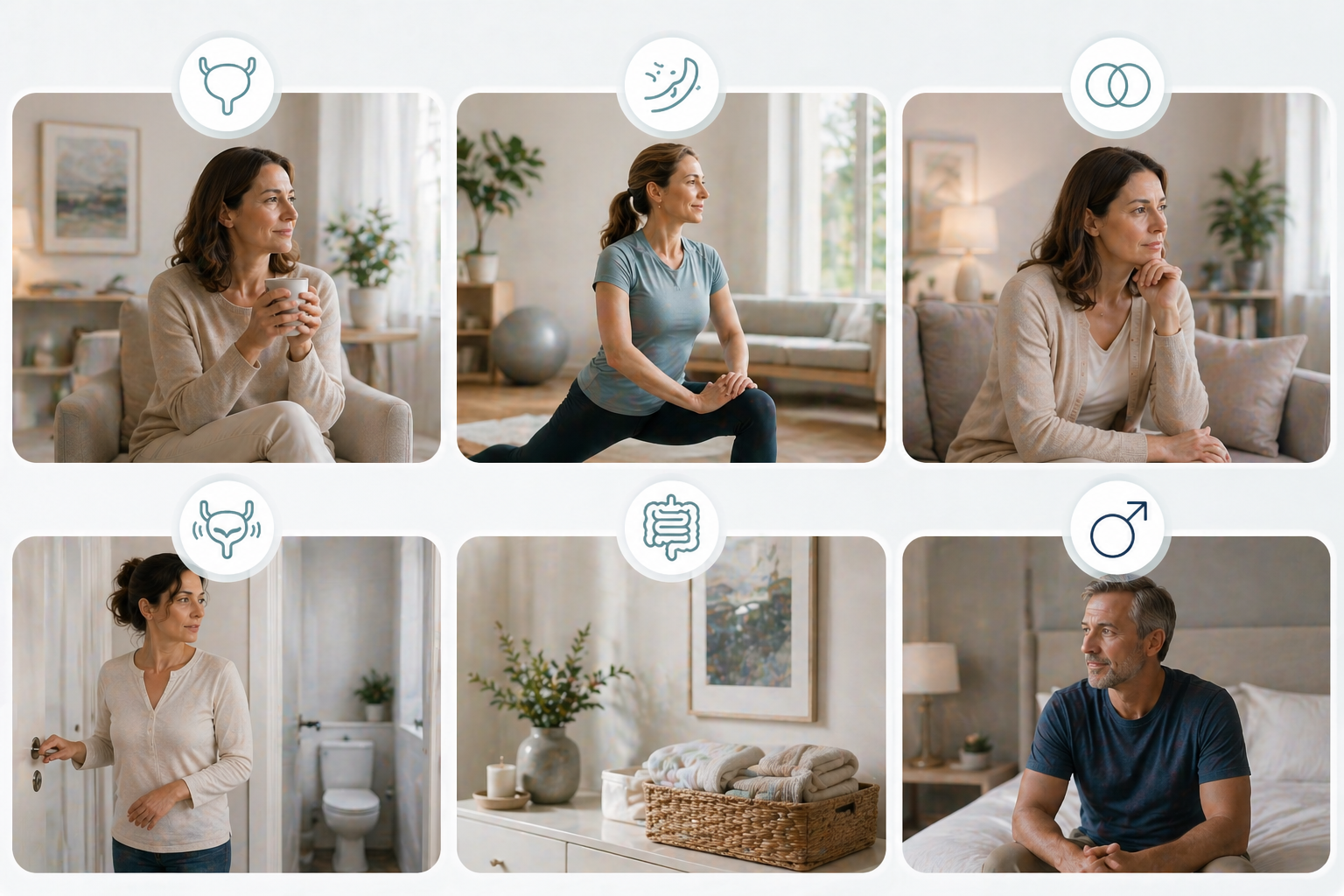
Several closely related concerns are addressed here, each with its own focus while sharing a single quiet, considered approach. The treatment areas described below are designed to feel cohesive rather than fragmented, so the journey forward feels manageable from the start.
One of the most common private concerns, where leaks quietly begin to affect movement and confidence. A calm, non-surgical pathway focuses on strengthening the pelvic floor and helping bladder control improve in everyday situations.
The kind of leakage that appears with a cough, sneeze, laugh, lift or moment of effort. Support is built around reinforcing the pelvic floor so the body feels better held during the everyday moments that matter.
When stress and urgency-related symptoms appear together, things can feel especially confusing. A reassuring, non-invasive route addresses both patterns with calm, careful attention rather than rushed answers.
Frequent trips, sudden urges and a sense that the bladder is dictating the day. A thoughtful approach helps ease that constant pull on attention so daily life feels less driven by the next signal.
One of the most private concerns of all, met here with respect, dignity and a clear path. A discreet, non-invasive approach focuses on strengthening the muscles that support bowel control.
A quiet, non-invasive route for men looking for help without surgery, needles or downtime. The focus is on supporting pelvic floor function and helping confidence return alongside it.
People do not arrive thinking in tidy clinical categories. They arrive thinking in real, lived moments. The questions running through their minds are the practical ones:
These are the questions that matter. A good service makes room for them. The approach here is designed to feel less like a clinical process and more like calm, considered guidance.
For one person, the difficulty might be leaks while coughing or lifting. For another, the urgency that keeps them close to a bathroom. For another, bowel control that quietly demands constant alertness. For another still, an interest in non-invasive support for intimate health and confidence. Some people arrive with several of these concerns at once. No single answer fits everyone, and the service is designed to recognise that.
People are seen, not just assessed from a distance. That is where genuine relief so often begins.
At the heart of this service is a calm, non-invasive approach that focuses on supporting the deep pelvic floor muscles. The thinking is simple. A stronger, better-coordinated pelvic floor often supports better bladder, bowel and intimate health, because so many everyday concerns connect back to the same group of muscles.
When pelvic floor support weakens, leaks may become more frequent. For people looking more closely at that kind of symptom, Can Incontinence Direct Treat Bladder Leakage explains the approach in more detail. Urgency can become harder to manage. Confidence can quietly drop. Exercise may start to feel risky. Private moments may feel less easy. The body still works in many ways, but it may no longer feel quite as dependable as it once did. A non-surgical approach is designed to help reintroduce that sense of dependability, in a way that is straightforward and comfortable to fit into life.
What appeals to many people is not only the physical possibility of improvement. It is the experience itself. The treatment is described as comfortable, performed while fully clothed and seated. There is no surgery and no downtime, which removes some of the practical and mental hurdles that often hold people back. After spending a long time quietly coping, the idea of starting something new can feel surprisingly heavy. A simpler, gentler route makes the first step considerably easier.
A calm conversation about what is going on, how long it has been there, and what it has meant for daily life.
A look at routines, goals and any earlier steps that have already been tried, so support feels well-fitted.
A non-surgical pathway tailored to the individual, explained in simple, manageable terms.
Short, comfortable sessions that fit easily into everyday life, with reassurance built into each step.
Urinary incontinence is one of the most direct challenges to confidence in everyday life. The leak itself is one part. The way it can quietly shape how a person moves through the world is another. It can build a careful caution into ordinary moments, an inner running commentary that grows tiring over time.
The non-surgical pathway here works to support the pelvic floor and help bladder control improve in real-life situations. The aim is to reduce leaks and help people feel comfortable again during the activities that fill an ordinary day. For many, the hoped-for change sounds modest from the outside but feels enormous from the inside: the freedom to laugh, move, lift, travel or simply make it through the day without thinking about leaks.
Although it is often associated with later life, urinary leakage can affect women after childbirth, men and women with pelvic floor changes, anyone navigating health transitions, and anyone whose body or routine has shifted over time. It can creep in quietly, which sometimes makes it harder to acknowledge. If it is affecting comfort, confidence or sleep, it is worth taking seriously, regardless of how small the symptom may seem.
The approach is built around calmness and clarity. There is a clear structure, a thoughtful explanation of each step, and a steady focus on helping the person understand what is happening and why. That clarity matters, because uncertainty can be just as draining as the symptom itself. When people feel they know the road ahead, they tend to feel far more able to walk it.

Stress incontinence is one of the most familiar forms of leakage, and one of the most disruptive in ordinary life. It tends to appear during simple, unguarded moments: a cough, a sneeze, a laugh, a jump, a lift, a long walk or a workout. Despite the name, it is not about emotional stress. It is about pressure on the bladder during effort, combined with a pelvic floor that may not be offering quite enough support.
What makes it especially frustrating is its place in the everyday. It interrupts moments that should feel free. The non-surgical pathway here works to strengthen the pelvic floor so the body feels better supported when those small but constant pressures arrive. The aim is simplicity and comfort: a process that does not become an additional source of strain.
Many people living with stress incontinence quietly start to shrink their world. They may step away from certain forms of exercise. They may begin to second-guess clothing choices. They may grow cautious in social settings, mentally checking their environment, the timing of meals and drinks, and the possibility of an unexpected laugh. Over time, that constant background calculation becomes its own quiet weight.
Support for stress incontinence is not only about the bladder. It is about giving back a measure of the freedom that has slipped away.
Mixed incontinence brings together features of more than one type of leakage. Stress-related symptoms and urgency-related symptoms can appear in the same person, sometimes in the same day, which can make patterns feel hard to predict or describe. That uncertainty can be exhausting, and it can leave people feeling that their concern is somehow more complicated than they can explain.
The non-surgical approach here is gentle and steady. It works to strengthen the pelvic floor and support better bladder control, with care given to the way different symptoms overlap. It is not a one-pattern process. It is a calmer, more attentive way of recognising what is going on.
What people usually want is not a complex theory. They want fewer symptoms taking the lead in their day. Less second-guessing. Less urgency. Less leakage. Less worry. A little more confidence in ordinary routines and a little less feeling of being pulled between competing concerns.
Mixed incontinence can feel especially deflating because it can seem like several things to manage at once. A service that meets it with a clear, structured approach can quietly bring the experience back into proportion. Symptoms are validated rather than minimised, and a defined pathway helps the person feel grounded in what to expect.
An overactive bladder is one of the more demanding continence concerns to live with, because the body keeps asking for attention, even when it is not really needed. Frequent trips. Sudden urges. The sense that the bladder is dictating the schedule rather than the other way round. For many, it can feel like a quiet alarm that never fully turns off.
Even when no leak occurs, the urgency itself can be tiring. The non-surgical approach here works calmly to strengthen the pelvic floor and ease the pressure that comes with that constant signal. The treatment is non-invasive and comfortable, and the surrounding tone is intentionally steady. That matters, because overactive bladder symptoms can heighten body awareness in unhelpful ways. A reassuring service should ease that, not amplify it.
People with overactive bladder symptoms often start to plan their lives around them. They may sit close to the exit. They may avoid longer journeys. They may wake repeatedly through the night. Meetings, travel, events and ordinary social plans can quietly become exercises in management. Over time, focus, sleep and confidence can all be affected.
This kind of support is not only about hoping to reduce urgency. It is about reclaiming small, ordinary freedoms. The ability to focus without distraction. A walk that feels relaxed. A more settled night. A little less anticipation of the next signal. Together, those small changes can make a meaningful difference to the way a day feels.
Bowel control concerns sit among the most sensitive a person can carry. Many people will not raise them with even their closest family or healthcare professional. They may feel embarrassed, guilty, or worried that the topic will land badly. That emotional weight can sit just as heavily as the physical experience itself.
The discreet, non-invasive approach offered here works to strengthen the muscles that support bowel control. The aim is to reduce symptoms in a way that feels manageable, dignified and entirely respectful of the personal nature of the concern.
The impact of bowel control issues reaches into social confidence, travel, work, sleep and the simple ability to relax fully outside the home. People may quietly avoid situations where they feel uncertain. They may map the location of every bathroom. They may carry an invisible weight of self-consciousness that no one around them sees. That kind of strain wears on a person over time.
When it comes to bowel control support, respect is the starting point. This is not a topic to be approached casually. People need to feel that they are not in the wrong, that their concern is taken seriously, and that there is a clear, calm route to a more comfortable place. A respectful service turns a deeply personal experience into a legitimate health matter that deserves real, considered attention.
Erectile health is too often spoken about in narrow terms, as though it concerns only physical performance. In reality, it can quietly affect self-worth, intimacy, mood and a man's sense of being present and capable in his own life. For many men, the silence around it carries as much weight as the symptom. The feeling that it must be handled alone. The worry that even raising it will be uncomfortable. The sense that the issue is somehow saying something larger than it really is.
The discreet, non-invasive approach here focuses on supporting pelvic floor function and helping things to feel more dependable again, without surgery, needles or downtime. Sessions are described as clothed and relaxed. For many men looking for support without invasive intervention, that simplicity comes as a real relief.
The physical side of the support is important, but the emotional shift can matter just as much. When the topic feels less charged, the man often feels heard rather than judged. The concern stops being a quietly held source of shame and starts to become a part of health that has practical, considered options. That shift can be profoundly meaningful.
Erectile concerns can connect to circulation, muscle support, stress, age and other health factors. The right kind of support does not assume a single, easy cause. It offers a calm, respectful place to explore what may genuinely help. The goal is to support confidence without making the experience feel clinical, exposed or awkward.
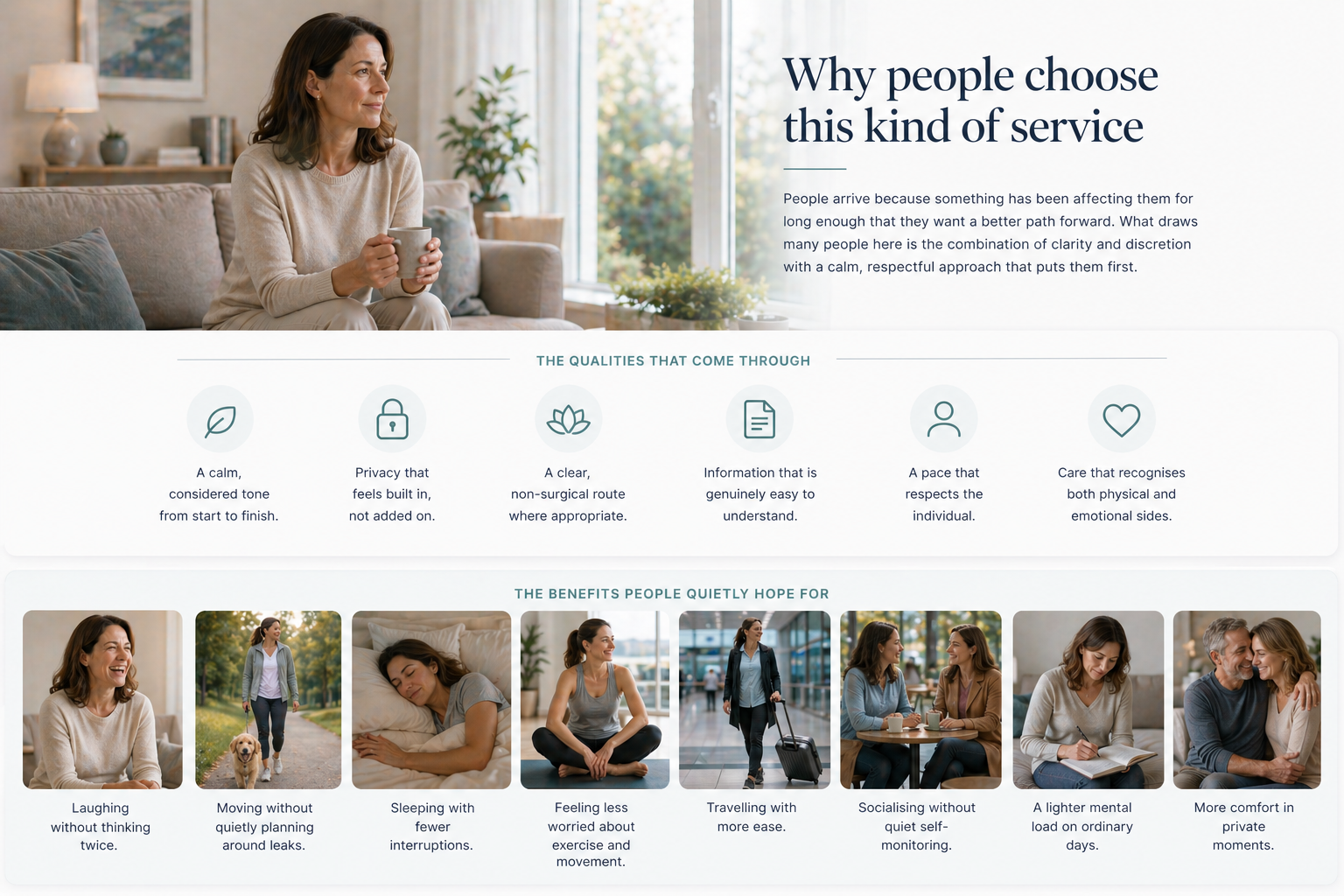
People rarely arrive at a treatment page just to browse. They arrive because something has quietly been affecting them for long enough that they want a better path forward. They may have tried to manage symptoms alone. They may have read widely and still felt unclear. They may have hesitated to talk about the issue at all.
What draws many people to this kind of service is the combination of clarity and discretion. The tone is steady rather than loud. Nothing is sensationalised. Sensitive topics are not dressed up. They are met with respect, calm explanations and the clear sense that the person matters more than the diagnosis on paper.
One of the most useful things any service can offer is a clear sense of what the journey looks like. People want to know what is happening, why it is happening and what comes next. Nobody enjoys having to guess. The treatment journey here is built to feel understandable from the start.
The first part is about understanding the person and their symptoms. This includes listening carefully, identifying the most pressing concerns, and recognising how those concerns are affecting daily life. From there, a calm, supportive plan is shaped around the individual.
Because the approach is centred on a non-invasive, seated treatment, the practical experience is straightforward. The person remains clothed. Sessions are short. There is no surgery and no recovery time. That simplicity is deliberate. It removes some of the small barriers that can quietly keep people from beginning.
Good treatment also gives the person a sense of control. They are not pushed into a decision. They are given information they can genuinely take in. They feel as though support is happening with them, not done to them. With concerns that are personal by nature, that feeling of agency is essential. People need to feel safe enough to engage, and respected enough to ask questions.
In a service like this, privacy is not an optional extra. It is part of the foundation. Many people arrive having held their concerns close for a long time, sometimes without ever telling a partner, friend or healthcare professional. The issue can be wrapped in a quiet, private routine. A thoughtful service understands this and behaves accordingly.
The experience is designed to feel low-pressure from the very first interaction. The tone is restrained. The language is respectful. Treatments are explained simply. Throughout, the focus is on helping the person feel comfortable in their own skin. That sense of privacy gently encourages the kind of honesty from which real progress begins.
There is dignity in a service that handles sensitive concerns without ever making them feel like a spectacle. The quiet message running through everything is simple: these are human concerns, and there is nothing shameful about asking for help.
Convenience matters more than it sometimes seems. Even a well-designed approach can feel difficult to begin if there are too many small obstacles in the way. Travel, time, energy, work and family commitments all influence whether someone is genuinely able to start.
For that reason, flexibility is important. Some people feel more comfortable receiving support in a home environment, where the experience feels especially private. Others prefer the structure and clear focus of a clinic setting. The best fit depends on the person, their symptoms and what feels easiest to manage.
Care should fit around people's lives, not the other way round. The easier the journey feels, the more likely a person is to follow it through with confidence.
People rarely arrive with a single, neatly labelled symptom. They often come carrying a mix of experiences that can be difficult to name. They may mention leaks while coughing or lifting. They may describe sudden urgency. They may speak about going to the bathroom often, or about a long-held worry around bowel control. They may notice a sense of weakness, a change in confidence, or a quiet shift in their intimate life. They may describe symptoms that have crept in slowly and grown larger than they would like.
This service brings together those connected concerns in one place:
What matters is this: nothing should feel too small to take seriously. If a symptom is affecting daily life in any way that genuinely matters to the person, it deserves real attention. Many people wait until they feel things have become severe before seeking help. In truth, even moderate symptoms can carry significant emotional weight, and there is no need to wait for a low point before exploring a calmer path.

Trust grows through consistency. It grows through calm tone, language that resonates, treatment that is explained in a way that makes sense, and most of all, a genuine sense of respect. When people feel listened to rather than judged, confidence has space to return. When they realise these concerns are not unusual and that there are clear, considered steps to take, the experience starts to feel more like guidance than struggle.
The aim is to make that supportive experience real and human. There is no need for grand presentation. Honest, understandable communication is far more reassuring. Most people living with private symptoms do not want a performance. They want steadiness. They want a service that is easy to approach and consistent enough to rely on.
Confidence often returns in small, quiet ways. Someone may begin sleeping more easily. They may step out of the house with less worry. Their laughter may feel a little freer. They may feel less guarded around exercise, intimacy or social settings. For those exploring support in that area, Incontinence Direct Erectile Dysfunction Therapy offers more information. At first these shifts may seem subtle, yet they add up to a meaningful change in how a person experiences their own day.
It is a discreet, human-centred space offering non-surgical support for continence, pelvic floor and intimate health concerns. The core treatment areas are brought together in one place so the experience feels clear and manageable.
It is for adult men and women living with urinary leakage, stress incontinence, mixed incontinence, overactive bladder, bowel control concerns, pelvic floor weakness or erectile health concerns who would like a private, considered way forward.
No. The approach is non-invasive and is performed while the person remains fully clothed. It is designed to feel comfortable, simple and easy to fit into ordinary life.
The treatment is described as straightforward and convenient, with no downtime afterwards. People are able to continue their day as normal.
The exact duration depends on the area being supported, but sessions are described as relatively short and easy to fit into a busy schedule.
Yes. The service is designed for adult men and women, with care shaped around the specific concerns of each individual.
Privacy is central. Everything from the tone to the structure to the way sensitive concerns are discussed is designed to help people feel at ease in addressing personal topics.
That is very common. Many people seek support after trying to manage symptoms on their own. A non-surgical, supportive approach can offer a different kind of starting point, particularly for those looking for something gentler.
No. If symptoms are affecting comfort, confidence, routine, sleep or wellbeing, they are worth addressing. There is no need to wait for things to feel severe before exploring support.
Not at all. These concerns can affect adults at many points in life. What matters is the impact symptoms are having, not age alone.
This service was created to support people with sensitive health concerns without the experience ever feeling cold, daunting or impersonal. The core treatment areas are brought together in one place, with the focus kept firmly on calm, non-surgical support that integrates into ordinary life.
Whether the concern is urinary incontinence, stress incontinence, mixed incontinence, overactive bladder, bowel control or erectile health, each area is approached with the same understated tone, the same respect for privacy and the same commitment to clear, considerate explanation.
The aim is not only to address symptoms. It is to help people feel more comfortable, more confident and more like themselves again. To make ordinary life feel a little easier. To quietly reduce background worry. To offer a clear, steady path that feels safe rather than alarming. To deliver care that feels less generic and more personal.
For anyone who has been quietly working around a symptom for too long, this can be the start of something kinder. A calmer conversation. A clearer understanding. A more human kind of support. Sometimes, that is exactly what is needed most.